The History of 48 Sussex Square
1 Walford Harmood Montague Selby, Diplomat
The 1901 Census shows Charles Edward Montague Selby living at this house with his wife, son and a couple of servants. His son Walford Harmood Montague Selby (1881-1965) was nineteen years old at the time and set for a glittering career. This account of Sir Walford’s his life is provided by the Bodleian Library, which holds the papers of Selby and his immediate family.
Sir Walford Harmood Montague Selby (1881-1965) was born in Brighton, the son of Charles Edward Montague Selby and Ellen Maria Harmood-Banner. He was educated at Charterhouse, Brighton College and Christ Church, Oxford, and in 1904 entered the Diplomatic Service as an attaché. His early career was divided between postings in Berlin and The Hague and spells at the Foreign Office. In 1911 he became assistant private secretary to Sir Edward Grey, the Foreign Secretary, and in 1918 spent a few months in the Grenadier Guards before being reclaimed by the Foreign Office at the armistice.
In 1919 Selby became First Secretary and Head of the Chancery at Cairo where his knowledge of Arabic helped his work with Lord Allenby, Special High Commissioner to Egypt, on the negotiations leading up to the abolition of the British Protectorate in February 1922. Selby returned to London that year and in 1924 began his long career as Principal Private Secretary to the Foreign Secretary, serving Ramsay MacDonald, Sir Austen Chamberlain, Arthur Henderson, Lord Reading and Sir John Simon.
In this capacity he attended the Locarno Conference in 1925. In 1932 Selby resigned from the Principal Private Secretaryship, and declined the post of Under-Secretary of State in favour of an appointment abroad. In 1933 he became British Minister in Vienna, one of the most important observation posts in Europe at the time. Selby was a strong supporter of Austrian independence, and became popular in Vienna. Edward VIII visited Austria in September 1936, returning to Vienna for five months following his abdication, and was frequently entertained at the British Legation. In December 1937 Selby moved to Lisbon as Ambassador, his final posting. With the outbreak of war the importance of Portugal, a neutral country, increased. Selby left Portugal and retired from the Foreign Office in December 1940. On his return to England Selby became involved in fund-raising for Austria and Poland. In the late 1940s he emigrated to Rhodesia (now Zimbabwe) where he worked on his book criticizing the Foreign Office between the wars, which was published as Diplomatic Twilight in 1953. Selby died in Salisbury (now Harare) in 1965.
2 David Pursey, Architect, 1933-2014
One-time resident of 48 Sussex Square
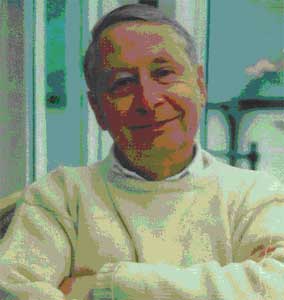
David made a valuable contribution to the conservation of houses of the Kemp Town Estate, managing, at one time or another, 23* of the 105 houses. He had a passion for the care of historic buildings and liked working with the resident freeholders of houses rather than for absentee investors.
David was a Southampton man who first qualified in architecture back in 1959. He built up a large practice in Worcester but sold up in order to get back to hands-on practice. He came to Brighton in the early 1980’s, lecturing part-time in architecture at Brighton Polytechnic while developing his design and freehold management practice here. Over the next thirty years he worked with scores of residents on the Estate. A quietly spoken and gentle man, he was ever professional in his behaviour and was liked and respected by his clients and local contractors. It was David who encouraged Tim Clark and Nick James to form their building maintenance company upon their former employer’s death. They continue to work on many houses of the Estate today.
Apart from the day-to-day repairs to our listed buildings, David oversaw the restoration and of three whole houses: Fife House for Todd Cooper and Giuseppe Sironi in 2001, 9 Sussex Square for Eugene Perera in 2003 and in the same year, 23 Lewes Crescent for Cate Blanchett, the latter project involving the now-legendary craning of a marble bathtub over the roof and into the house.
David believed that we are custodians of these fine buildings, to be enjoyed by generations to come. Towards that goal David gave devoted service. His assistant Chung-Ju Lee continues to run his practice today.
Andrew Doig 2016
* Houses at one time managed by David: No.10 Chichester Terrace, Nos.3,11,16,20-22,24 and 28 Lewes Crescent, Nos. 7/8,12,14,18,24,41,42,48,49/50 Sussex Square and Nos.2,4 and 9 Arundel Terrace.
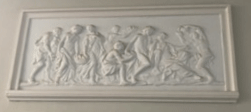
Bas Relief
The book, Hidden Treasures on the Kemp Town Estate by Vanessa Minns, published by KTS in 2023, illustrates and documents the provenance of all the 40 bas reliefs on the Estate and indicates where they can be found in other Houses in this country (Chatsworth, Osborne House). It can be purchased on Amazon.